
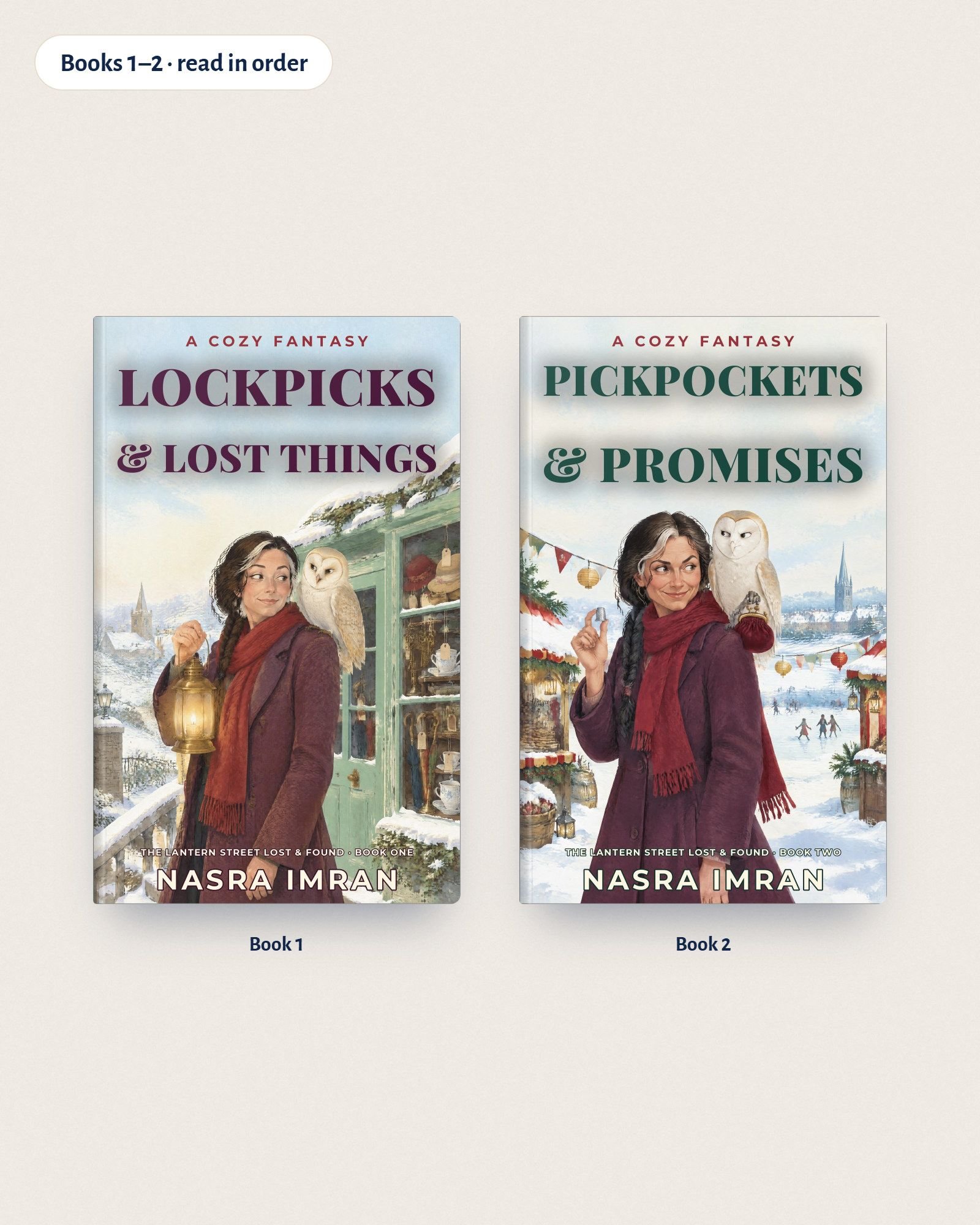
The Lantern Street Lost & Found · Book 1 · read first
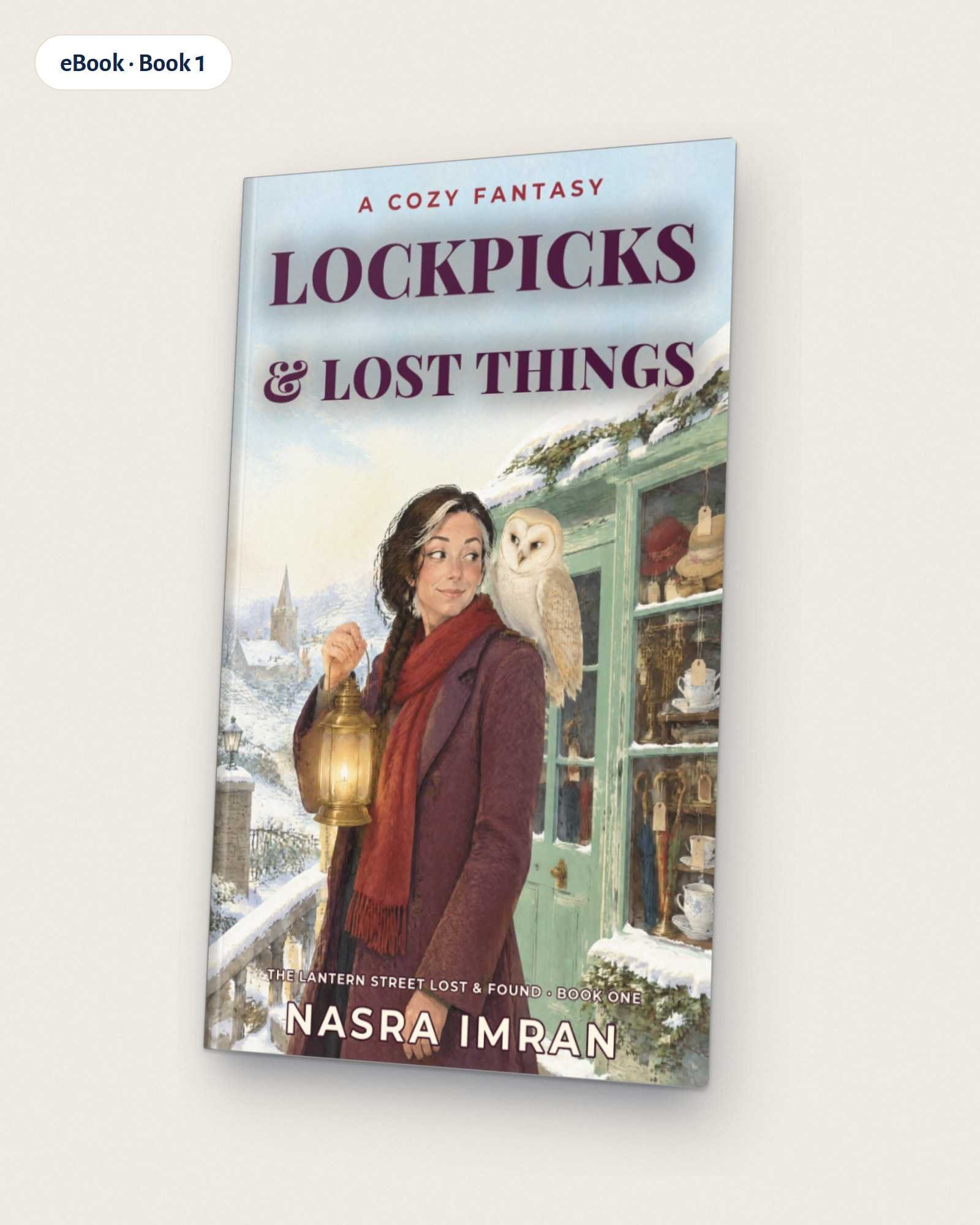
Lockpicks & Lost Things
The kingdom's best thief has retired. Now her whole job is giving things back.
- Found family
- Low stakes
- Closed door
- No spice
- Happy ending
$4.99
Get the eBook · $4.99- Instant download, emailed to you
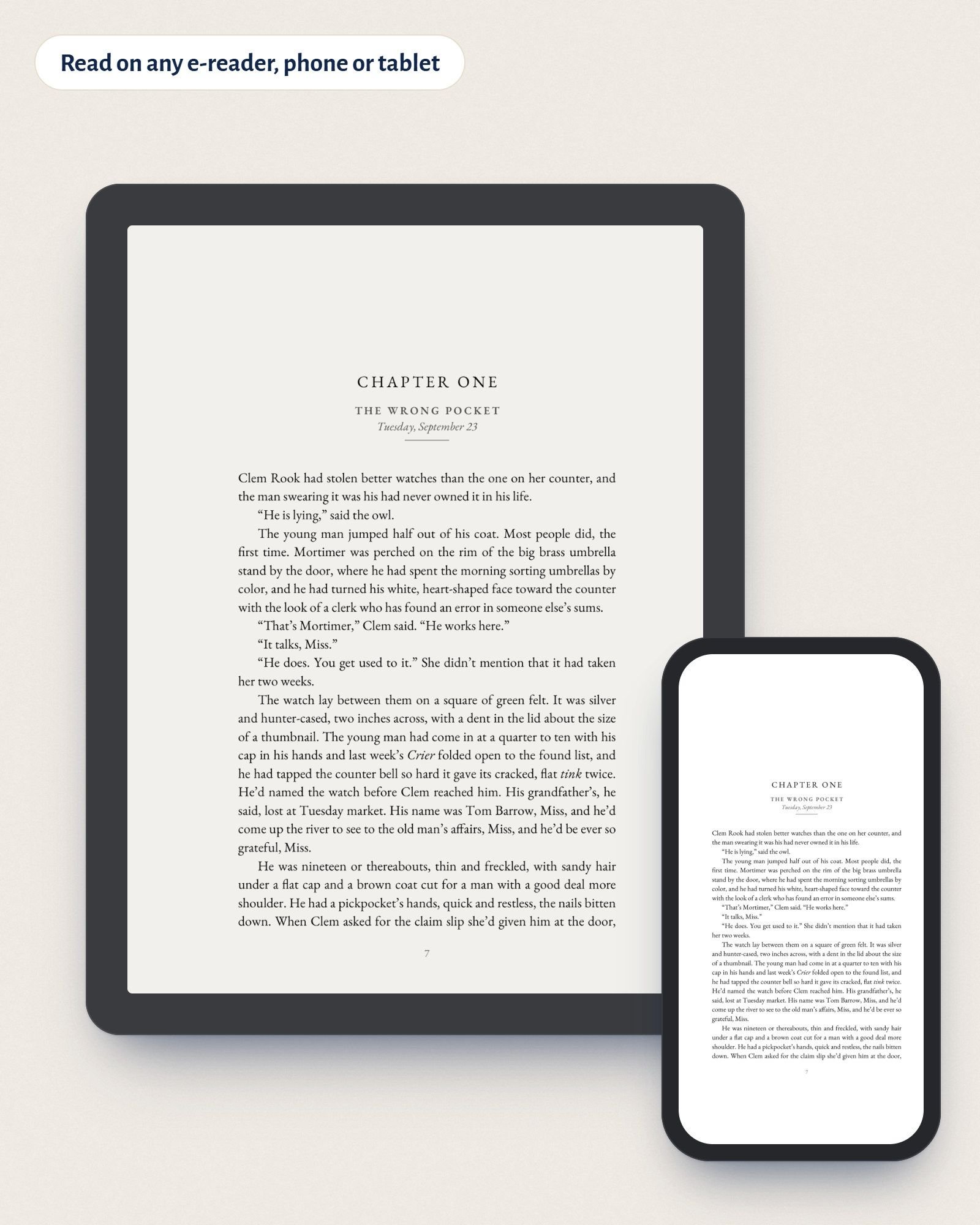
- Read on a phone, tablet, e-reader or computer
- Secure checkout by Payhip
The story
For twenty years Clem Rook made her living taking things that belonged to other people. Now she keeps the magical Lost & Found on Lantern Street, where the old oak shelves hum when an owner comes near, and a sixty-four-year-old barn owl files the umbrellas by color and disapproves of her on principle.
The town council has one condition. Return the office’s oldest unclaimed treasure, a sealed brass lantern nobody has opened in forty years, by first snow, or the doors close for good and Clem loses the only home she has ever chosen.
The trouble is that the lantern was locked by a master. The captain of the town watch is certain the new keeper is up to something. And the deeper Clem digs, the more the lantern seems to have been waiting for exactly one person: the Magpie, the thief she swore she’d stopped being.
A warm, funny cozy fantasy about second chances, found family, a very opinionated owl, and the courage to hand back what was never yours.
Read Chapter 1 free
Open Chapter 1 (about 10 minutes)
Chapter one
Clem Rook had stolen better watches than the one on her counter, and the man swearing it was his had never owned it in his life.
“He is lying,” said the owl.
The young man jumped half out of his coat. Most people did, the first time. Mortimer was perched on the rim of the big brass umbrella stand by the door, where he had spent the morning sorting umbrellas by color, and he had turned his white, heart-shaped face toward the counter with the look of a clerk who has found an error in someone else’s sums.
“That’s Mortimer,” Clem said. “He works here.”
“It talks, Miss.”
“He does. You get used to it.” She didn’t mention that it had taken her two weeks.
The watch lay between them on a square of green felt. It was silver and hunter-cased, two inches across, with a dent in the lid about the size of a thumbnail. The young man had come in at a quarter to ten with his cap in his hands and last week’s Crier folded open to the found list, and he had tapped the counter bell so hard it gave its cracked, flat tink twice. He’d named the watch before Clem reached him. His grandfather’s, he said, lost at Tuesday market. His name was Tom Barrow, Miss, and he’d come up the river to see to the old man’s affairs, Miss, and he’d be ever so grateful, Miss.
He was nineteen or thereabouts, thin and freckled, with sandy hair under a flat cap and a brown coat cut for a man with a good deal more shoulder. He had a pickpocket’s hands, quick and restless, the nails bitten down. When Clem asked for the claim slip she’d given him at the door, he searched three pockets before he found it. People knew where they kept things in their own coats. They didn’t have to go looking.
And twice while he talked, his eyes had left her face and climbed past the rolling ladders and the hand-painted aisle signs to the top shelf of Aisle 7, where nothing sat but an old brass lantern nobody had bothered to take down in forty years.
Under her palms the counter hummed. It was a low note in the old oak, felt more in the teeth than heard, and it meant what it always meant. The owner of something on these shelves had come near. It did not say who. It never said who. There were two claimants in the front room this morning, and the hum was about as much help in choosing between them as a dog that barks at every knock.
The second claimant sat on the bench under the front window. Hattie Cobb ran the bakery across the street. She had come in five minutes behind Tom Barrow, seen the watch on the felt, and sat down hard with her own slip crushed in one floury fist. She had not said a word since, which Clem had not known was possible.
“He stood on the front step for some time before he came in,” Mortimer said. “He said his name to himself four times. He was practicing.”
“I wasn’t,” said Tom Barrow.
“You also said Miss each time. You have said it six times since.”
“The charter doesn’t accept owls as witnesses,” Clem said. “I’ve asked.”
“It is a poor charter.”
For twenty years Clem had made her living taking things that belonged to other people. Now people came in through a green door on Lantern Street and she handed things back, and the town paid her five crowns a month and the rooms upstairs to do it. The work had rules, and the oldest of them was Article 4 of a charter older than anyone’s great-grandmother. A claimant proved ownership by exact description, two details not visible at a glance, or by the keeper’s judgment.
Her judgment was already made. She wanted the proof anyway. Proof was kinder to everyone, liars included.
She turned the watch face-down on the felt and rested two fingers on the case.
“There’s an engraving inside the lid,” she said. “What does it say?”
Tom Barrow’s eyes went down.
That was all it took. Honest people looked up when you asked them to remember something, up and a little to one side, toward wherever they kept the past. Tom Barrow fixed his eyes on the closed silver under her fingers, as if he might read it through the case if he only stared long enough.
“His name, Miss,” he said. “And a year.”
Clem looked past him. “Mrs. Cobb?”
Hattie stood so fast the bench scraped. She was round-faced and red-haired under a blue kerchief, with flour to the elbows and laugh lines she wasn’t using this morning. “It says N.S., and then forty years at the stones. The men at the mill had it cut for him when he gave up the millstones. The dent’s from the mill steps, ten years back, he went down them faster than he meant to.” She swallowed. “And it runs four minutes fast. He keeps it that way on purpose. Dad likes to be early.”
Clem thumbed the catch. The lid sprang up, and there it was inside, in worn script: N.S. — forty years at the stones.
Up the hill on the green, the tower clock began to strike ten. Clem counted the strokes and turned the watch over. Its hands stood at four minutes past.
Hattie made a small noise, the sort a kettle makes just before it decides to sing.
“Must be a different watch, Miss,” said Tom Barrow. “My mistake. Sorry, Miss.” He was already backing toward the door. He didn’t argue, and he didn’t ask to see the engraving for himself, and those two things told Clem more than his eyes had. A man who’d truly lost his grandfather’s watch would have argued until his ears went red. Tom Barrow had never wanted the watch at all.
At the door he looked up once more, past her, past the counter, to the top shelf of Aisle 7. Then again, quick, the way you check a window you mean to come back to.
The door bell jingled on its spring. A tall man in a dark-blue coat stepped aside on the threshold to let him by, then turned and watched him all the way down the hill toward the Landing.
“Captain!” Hattie held the watch up in both hands. “Look. Dad’s watch. Some boy tried to walk off with it, the nerve of him, and she knew. She knew.” She came round the end of the counter, seized Clem’s hand in both of hers, flour and all, and squeezed until the knuckles creaked. “Don’t you move. I’m coming back.” Then she was out the door and across the cobbles with her skirts in one fist and her father’s watch in the other.
The tall man came in. He shut the door behind him, opened it, shut it again, and tried the latch twice with his thumb.
“It’s a good latch,” Clem said. “You can stop testing it.”
“Noted.” He let go of it.
He was a head taller than she was and broad through the shoulders, with close-cropped dark hair gone gray at the temples and a short dark beard. His nose had a bump in it from some old break. His eyes were gray-green, and they went everywhere in the room in the space of a breath: the green ledger on its slant desk, the iron stove, the ladders, the owl, her. The long blue watch coat had brass buttons down the front, all but one. The third from the top was pewter, dull among the bright ones, sewn on with small careful stitches and never replaced.
Clem took all of that in the way she took in doors and windows, and then she noticed him looking at her hands.
They lay flat on the counter, perfectly still. She kept them that way whenever someone was watching them. He was watching them now. He saw her see it. Neither of them said a thing.
“Captain Abel Hart,” he said. “Copperbell Watch.”
“Clem Rook. Lost and Found.”
“I know.” He glanced back at the door. “Your customer left in a hurry.”
“He’d lost the wrong watch.”
“He was watching your shelves.”
“Everyone looks at my shelves. They’re very good shelves.”
He didn’t smile. Something near his eyes considered it and decided against. He took a folded paper from inside his coat, sealed in green wax with the town’s bell, and laid it on the counter between them, squared to the edge.
“The council sat last night,” he said. “I was asked to bring you this by hand.”
Clem broke the seal.
By resolution of the Council of Copperbell, the twenty-second day of September, 1186, carried three votes to two. The Lantern Street Lost & Found costs the town one hundred and twenty crowns a year that the town does not have. The office shall be closed and its building sold, unless before the first snow of this year the keeper returns the oldest unclaimed item in its care to its rightful owner. Signed, Edith Plumb, Councilor, for the Finance Committee.
She read it twice. Then she looked over her shoulder at the top shelf of Aisle 7.
The lantern sat alone up there, nine feet off the floor, out of reach of everybody’s elbows. It was a ship’s lantern, or dressed as one. It had a squat brass body gone green-brown with age, a domed cap with a ring on top for carrying, and a band of thick ribbed glass round the front, red on one side and green on the other. A card in a brass sleeve hung from the ring on a length of green cord. The rest of the shelf was bare. Even the dust seemed to keep a respectful distance.
“Number three hundred eleven of eleven forty-six,” Mortimer said from the umbrella stand. “Sealed. Unclaimed. I have never cared for it.”
“Councilor Plumb moved to close the office outright,” Abel said. “The Chair added the lantern.”
“Out of kindness?”
“It’s sat there forty years.” Nothing in his face moved. “Call it a long kindness.”
Clem folded the notice along its creases. “So if I can’t give that lantern back to whoever owns it by first snow, they shut the office and sell the building.”
“That’s the size of it.”
“And everything on the shelves?”
“Auction. The charter says so.” His gaze went up to the roost beam, where Mortimer had flown while they talked, without a whisper of sound, and now sat looking down at them both. “Is the owl part of the staff?”
“I am the staff,” said Mortimer. “She is temporary.”
Abel looked at the owl. The owl looked at Abel. Clem had the distinct impression that two reports were being written, one on each side.
“If your friend in the big coat comes back,” Abel said at last, “send word to the watch house.”
“Why?”
“People who look at shelves like that usually come back.” He touched two fingers to his brow, turned, and went out. The bell went on its spring behind him.
He did not test the latch on his way out. She noticed that, too, and suspected it had cost him something.
The front room settled round her. The stove on the left wall ticked as it cooled. Her dented copper kettle sat on top, and beside the door the umbrella stand stood crowded with handles, sorted, as Mortimer liked them, from red at one end through to the hated blacks at the other. The room smelled of beeswax and, faintly, of whatever Hattie had in her ovens across the street. Under Clem’s palms the counter had dropped back to the building’s low note. The watch had gone home, and its hum had gone with it.
She climbed the stairs to her rooms.
It was one room, really, with a bed and a washstand, a two-ring stove in the corner, and a window seat that looked down on Lantern Street. Her shirts were folded in the drawer. Her second pair of boots stood under the washstand, side by side. Her comb lay on the sill. In thirty-eight years she had never once emptied a bag all the way to the bottom, and six weeks ago, in this room, she had. The only thing she had not unpacked was the sea trunk at the foot of the bed, and that held only what she had decided never to need again.
She stood in the doorway with her eyes on the shirts in the drawer for longer than a sensible woman would.
Then she went back down and put the kettle on, because she was keeping this place, and that was all there was to it.
Hattie was back within the hour with a paper sack gone see-through in spots from the sugar. “Cider doughnuts,” she said, “and don’t you dare say I shouldn’t have.” She set the sack on the counter, took one look at Clem’s face, and pointed at the stool. “Eat first, then tell me.”
The doughnuts were still warm, dark gold and crusted with cinnamon sugar, and the first one was gone before Clem had decided how to begin. She ate a second while Hattie read the notice, and watched Hattie’s mouth get smaller with every line.
“Three to two,” Hattie said. “Over that.” She glared up at the lantern as if it had voted. “Forty years it’s sat there. Who’s going to walk in for it now?”
“Somebody owns it.”
“Somebody owned it. In eleven forty-six.” Hattie folded the notice with sharp, floury creases. “Dad cried, you know. When I put it in his hand. He hasn’t cried since the mill. He sat up in bed and wound it and set it four minutes fast all over again, and then he cried.” She pushed the sack across. “Eat the third one. I’ll ask around. Everybody comes into my shop sooner or later, and half of them talk with their mouths full.”
When she had gone, Clem opened the ledger on its slant desk at the right end of the counter. Sixty years of Copperbell’s lost things were written in it, one line at a time. She found the watch’s entry, number 274 of this year, found by the bandstand on the sixteenth, and wrote in the last column in her smallest, neatest hand: Claimed, 23 Sept., by H. Cobb for her father.
“Write it tidily,” Mortimer said from the beam. “That book has been missing a tooth for forty years. It does not need another gap.”
Clem’s pen stopped. “Missing a tooth?”
“So the old keeper said, every spring, when he counted the pages. I cannot read. I can only remember what people mutter.” He settled his feathers. His autumn coat was not yet fully in, and he looked a little moth-eaten about the shoulders, which he did not like to have mentioned.
She looked up at the lantern on its high shelf, at the red and green glass gone dull under forty years of patience.
A man with a too-big coat had checked it twice from the door.
The tower clock struck four. Clem wiped the sugar from her fingers, one at a time.
“First snow comes mid-December here, doesn’t it?” she said. “The almanac at the store says the fourteenth.”
Mortimer turned his pale face toward the window.
“First snow came on the ninth of November,” he said, “in eleven sixty-one.”
That's the end of Chapter 1. The rest of Lockpicks & Lost Things is waiting.
Get the eBook · $4.99Reading order
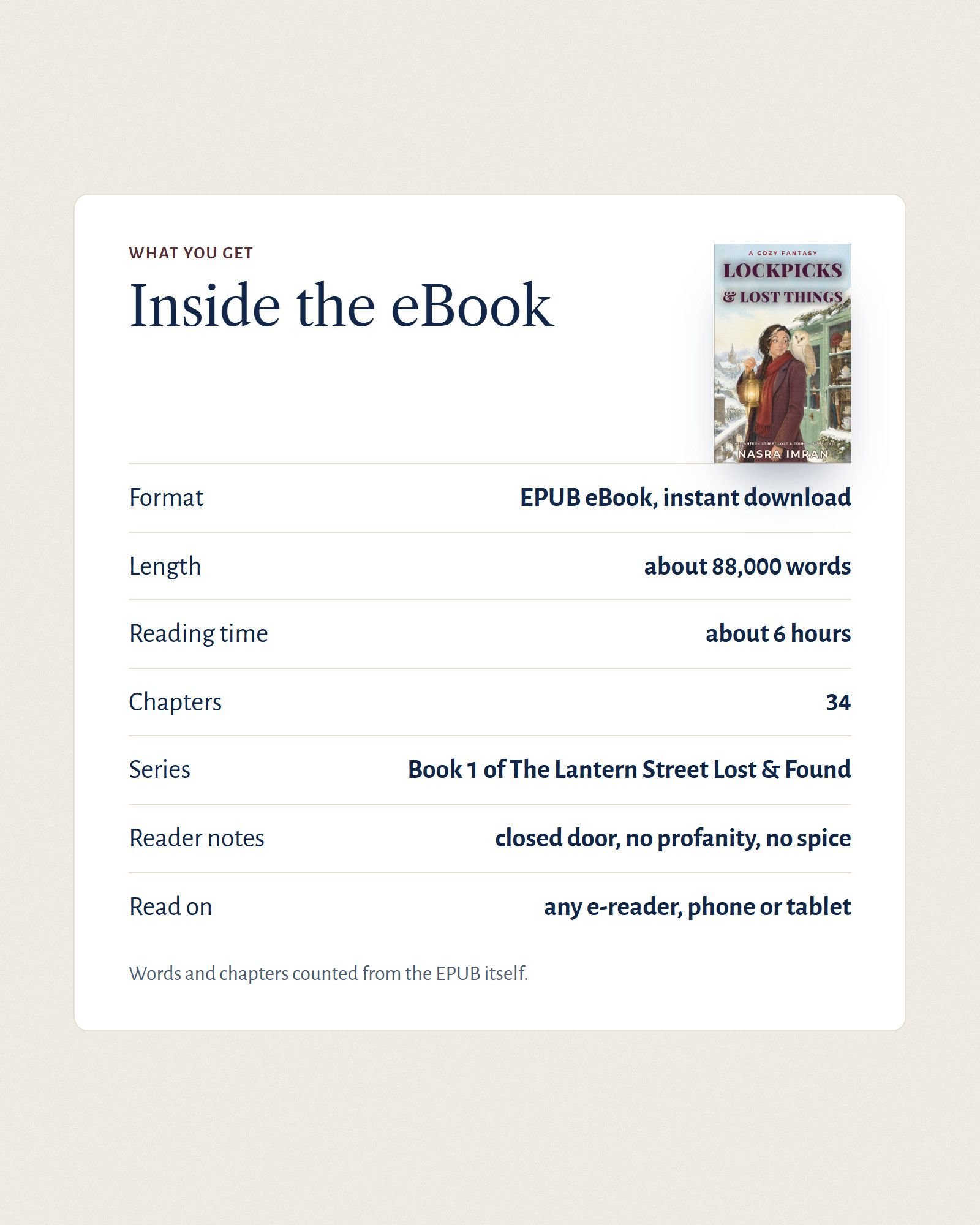
What you get
- FormatEPUB eBook, instant download
- LengthAbout 88,000 words
- Reading timeAbout 6 hours
- Chapters34
- SeriesBook 1 of The Lantern Street Lost & Found
- Read onAny e-reader, phone or tablet
Who it's for
- Readers who love cozy fantasy, low stakes and small-town magic
- Fans of found family, second chances and slow-burn romance
- Readers who prefer closed-door romance with no spice
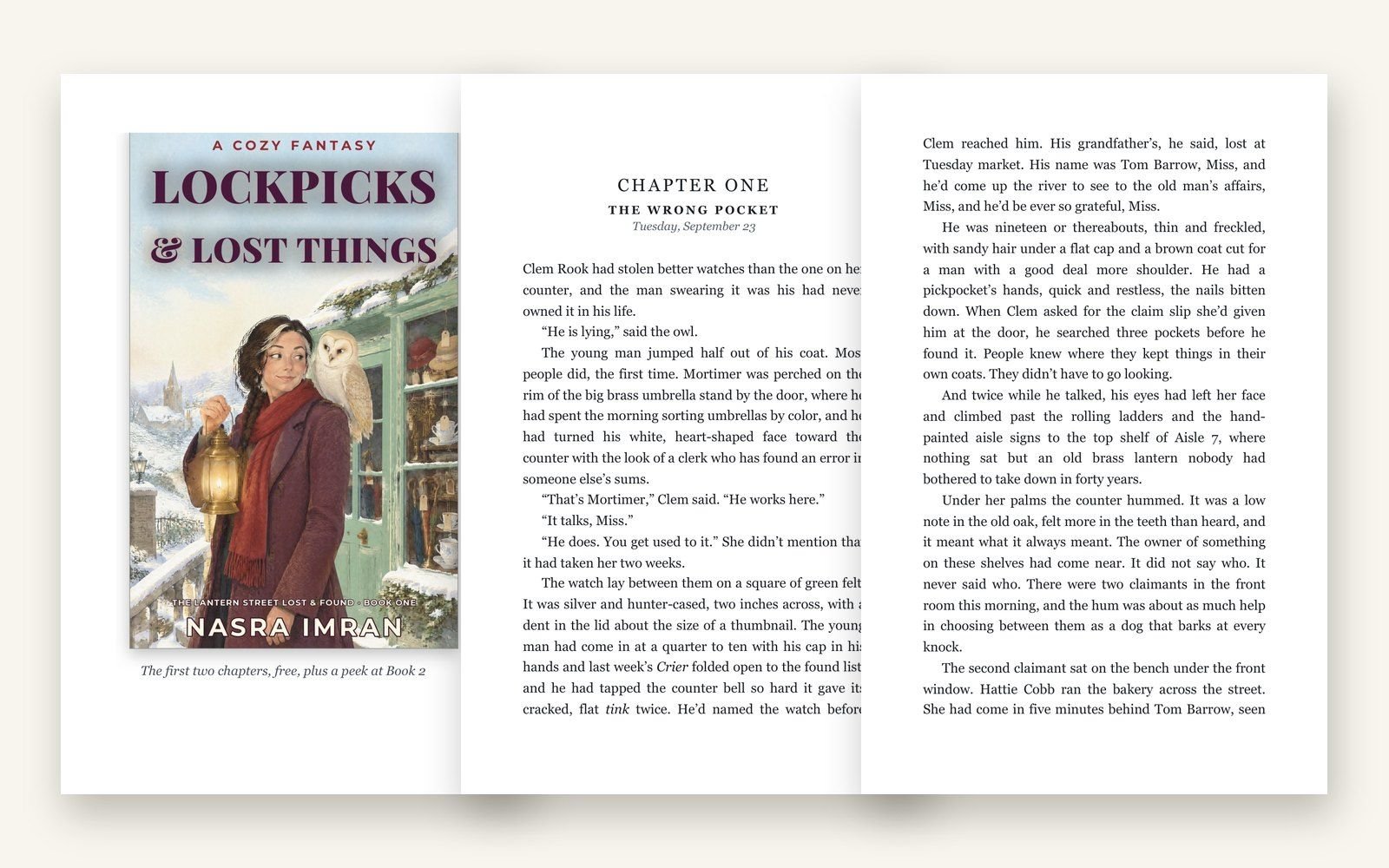
Free gift
Free: Lockpicks & Lost Things: first 2 chapters
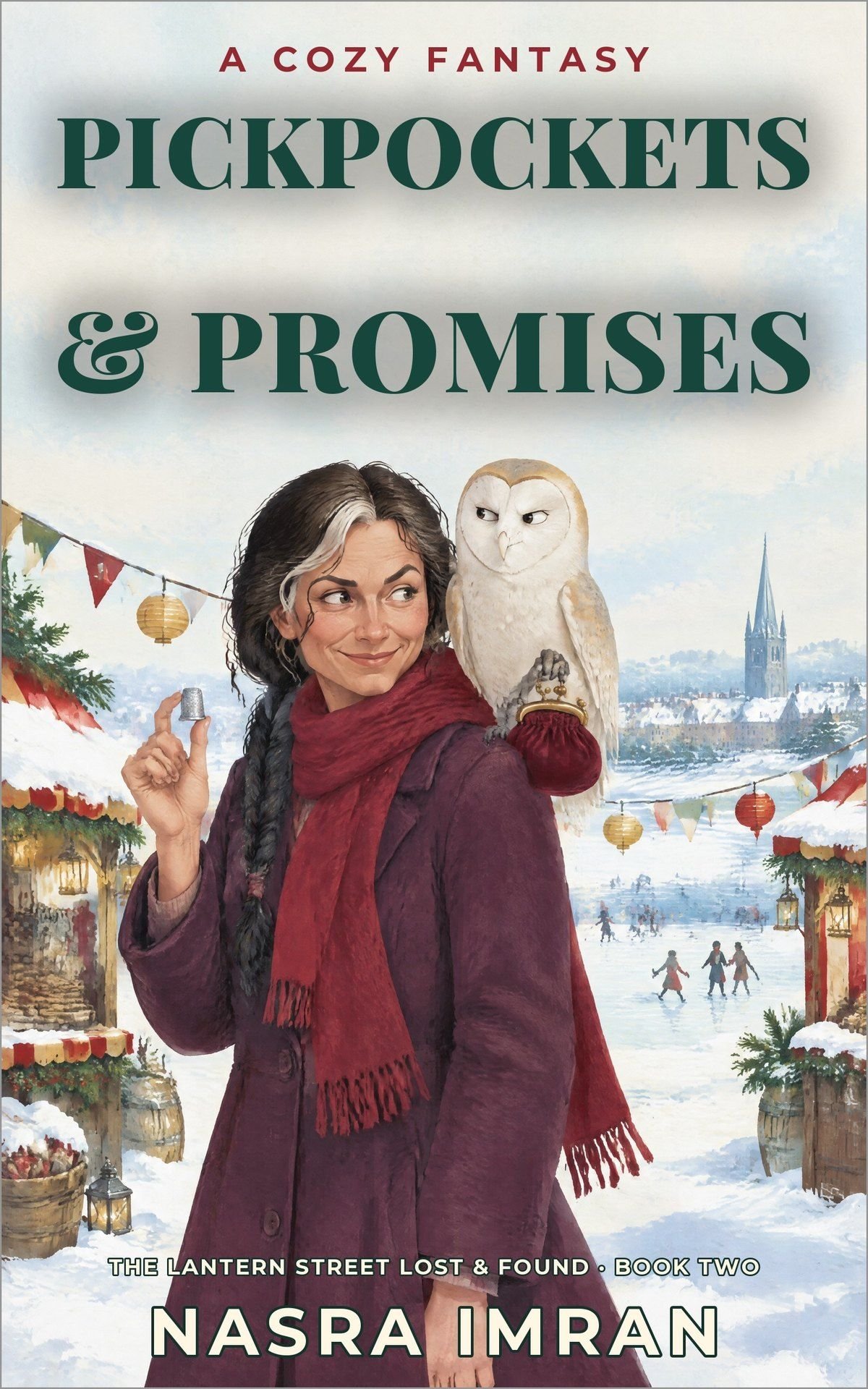
Start the cozy fantasy free, with a peek at Book 2. Found family, gentle capers and one very opinionated barn owl.
Questions
How do I get my eBook?
Right after you pay, Payhip shows your download link and emails it to you. On a phone, open the email's link in Safari or Chrome, not inside the email app, and save the EPUB. Not in your inbox? Check Promotions or spam.
Reading it on your e-reader, phone or tablet
The EPUB opens in Apple Books, Google Play Books, Kobo and most e-reader apps. Our Reading on your device page has steps for each device.
Content notes
Cozy fantasy with a closed-door, slow-burn romance (no spice): kisses on the page, the door stays closed. No profanity.
Is there spice?
No. The romance is slow-burn and closed-door. Kisses on the page, and the door stays closed.
Problem with your file?
If your file won't download or open, isn't what we described, or has a mistake, email us at community@oneandonlystories.com within 30 days of purchase. We'll send a fixed file or a full refund, your choice. Because these are instant downloads, we can't refund a change of mind, but a real person will always help you get the file working first.
Written by Nasra Imran
Novels for adults: warm cozy fantasy, psychological thrillers about marriages with secrets, and closed-door love stories about second chances and the people who leave a light on for us.
More from Nasra Imran