

Holly Street Christmas · Book 1
Ex Marks the Mistletoe
Fake dating their ex. Real feelings. Five days to survive Christmas.
- Closed door
- Kisses only
- No swearing
- Happy ending
$0.99
Get the eBook · $0.99- Instant download, emailed to you
- Read on a phone, tablet, e-reader or computer
- Secure checkout by Payhip
The story
Libby Shaw lights stages for a living. She can make a room glow, make a whole audience cry on cue, and she has not let anyone close enough to see her in five years. Not since she ended things with Jonah Avery two days before Christmas.
Now her grandmother has invited Jonah to the last Christmas in the family house in Decatur, Georgia, the one famous for her late father’s Christmas lights. And she has told the whole family they’re back together.
Nobody has the heart to tell an eighty-eight-year-old she’s wrong. So Libby and Jonah make a deal: pretend until Christmas, then a quiet January breakup.
The only problem? Jonah is still the steadiest, kindest man she knows. And somewhere between the tree farm, a snow machine that refuses to work and the longest night of the year, the pretending stops feeling fake.
Read Chapter 1 free
Open Chapter 1 (about 10 minutes)
Chapter one
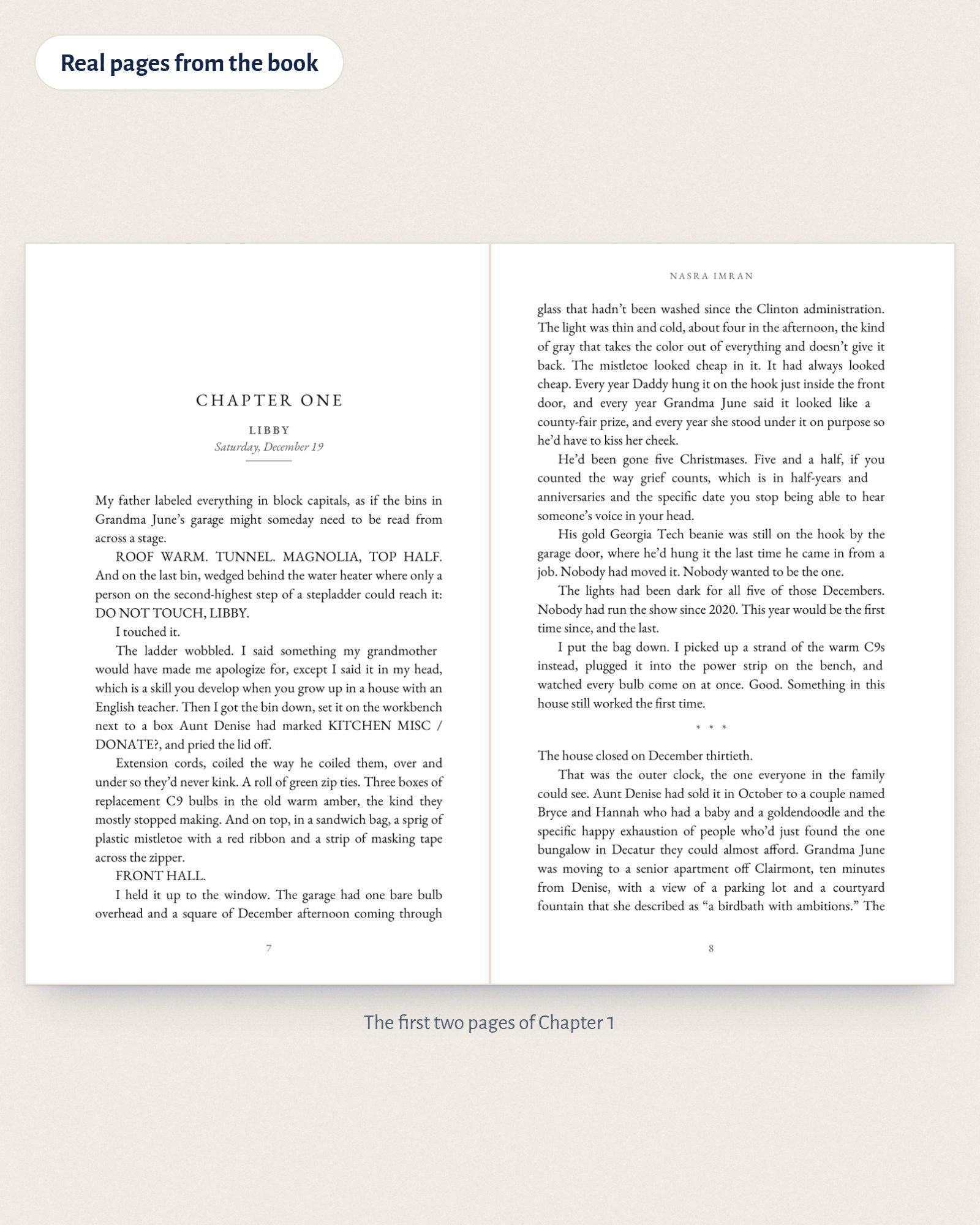
My father labeled everything in block capitals, as if the bins in Grandma June’s garage might someday need to be read from across a stage.
ROOF WARM. TUNNEL. MAGNOLIA, TOP HALF. And on the last bin, wedged behind the water heater where only a person on the second-highest step of a stepladder could reach it: DO NOT TOUCH, LIBBY.
I touched it.
The ladder wobbled. I said something my grandmother would have made me apologize for, except I said it in my head, which is a skill you develop when you grow up in a house with an English teacher. Then I got the bin down, set it on the workbench next to a box Aunt Denise had marked KITCHEN MISC / DONATE?, and pried the lid off.
Extension cords, coiled the way he coiled them, over and under so they’d never kink. A roll of green zip ties. Three boxes of replacement C9 bulbs in the old warm amber, the kind they mostly stopped making. And on top, in a sandwich bag, a sprig of plastic mistletoe with a red ribbon and a strip of masking tape across the zipper.
FRONT HALL.
I held it up to the window. The garage had one bare bulb overhead and a square of December afternoon coming through glass that hadn’t been washed since the Clinton administration. The light was thin and cold, about four in the afternoon, the kind of gray that takes the color out of everything and doesn’t give it back. The mistletoe looked cheap in it. It had always looked cheap. Every year Daddy hung it on the hook just inside the front door, and every year Grandma June said it looked like a county-fair prize, and every year she stood under it on purpose so he’d have to kiss her cheek.
He’d been gone five Christmases. Five and a half, if you counted the way grief counts, which is in half-years and anniversaries and the specific date you stop being able to hear someone’s voice in your head.
His gold Georgia Tech beanie was still on the hook by the garage door, where he’d hung it the last time he came in from a job. Nobody had moved it. Nobody wanted to be the one.
The lights had been dark for all five of those Decembers. Nobody had run the show since 2020. This year would be the first time since, and the last.
I put the bag down. I picked up a strand of the warm C9s instead, plugged it into the power strip on the bench, and watched every bulb come on at once. Good. Something in this house still worked the first time.
The house closed on December thirtieth.
That was the outer clock, the one everyone in the family could see. Aunt Denise had sold it in October to a couple named Bryce and Hannah who had a baby and a goldendoodle and the specific happy exhaustion of people who’d just found the one bungalow in Decatur they could almost afford. Grandma June was moving to a senior apartment off Clairmont, ten minutes from Denise, with a view of a parking lot and a courtyard fountain that she described as “a birdbath with ambitions.” The boxes had started in November. By now the boxes owned the house. They lined the hall in towers, labeled in Denise’s loopy Sharpie, and every time I passed one I had the urge to rearrange them by height so the sightlines would be better.
I am a lighting designer. I can’t help it. I walk into a room and see where the shadows fall.
The inner clock was in my back pocket, and only I could hear it ticking.
I took my phone out on my way through the back door and read the email again, standing on the step where the light from the kitchen hit the screen.
Libby. The producers love you. The theater’s grid is a nightmare and you’re the only one who already knows this show in her bones. I need your answer by the 26th. Say yes. Merry Christmas. S.
Simone Ward did not use exclamation points. She didn’t need them. She had directed Porchlight at the Midtown Rep last spring, a musical about a widowed mother and a broken-down boarding house that had no business making grown men cry in the third row, and it had made grown men cry in the third row for eleven weeks. Now it was going to Broadway. The transfer had been announced the week before Thanksgiving. Load-in in March. A real theater on Forty-Fifth Street with a real crew and a real budget and a lighting design that would have my name on it. If I said yes.
I had three drafts saved. The first one said Yes! Thank you so much! in a tone that made me want to apologize to myself. The second one said I’d love to, but with my family situation right now and then just stopped, because I couldn’t figure out how to finish the sentence without sounding like I was using my grandmother as a shield. The third one was blank except for the word Simone, followed by a comma, which I’d been looking at for six days.
I put the phone back in my pocket and went inside.
The kitchen was the warmest room in the house and the worst lit. Grandma June had a fluorescent ring in the ceiling that she’d installed in 1983 and refused to replace on the grounds that it still worked. It turned everything faintly green. Under it, at the yellow Formica table, my family looked like a scene I’d never be allowed to light.
My mother was at the old upright in the corner of the living room, which you could see through the wide doorway, playing “In the Bleak Midwinter” slow enough that it sounded like a question. She played when she didn’t want to talk. She’d played a lot in the last five years.
Aunt Denise was on the phone with Uncle Kevin, who inspects houses for a living and argues with his wife for sport, about the inspection report, one finger in her other ear, pacing the strip of linoleum between the stove and the refrigerator. “No. No. The gutters are fine, Kevin, the gutters were cleaned in October, I have the receipt.” She saw me and pointed at a plate of cheese straws on the counter, which meant eat something, and then pointed at me, which meant you look tired, and then pointed at the ceiling, which I didn’t understand at all.
Mason was under the table.
“What are you doing down there?” I asked.
“Waiting,” said my little cousin, who was seven and took everything seriously. His parents were both nurses at Children’s and both working through Christmas week, so he was spending it with his grandmother, which meant he was spending it with us. He had Denise’s chin and his father’s eyelashes and a dinosaur sweatshirt with a hole in the elbow. “Grandma Denise said I can flip the big switch this year.”
“The Lights-On isn’t till Monday.”
“I know. I’m waiting.”
Fair enough.
Grandma June sat at the head of the table with the crossword, a pencil, and her reading glasses on a beaded chain around her neck. She did the crossword in pencil because she said pen was for people who’d never been wrong, and she’d met those people, and they weren’t fun at parties. She looked up when I came in. She looked at my hands, which were dusty from the garage, and then at my face, which I assume was the same.
“You found the bins,” she said.
“I found the bins.”
“Did you find the one that said not to touch it?”
“Mm-hm.”
“Your daddy wrote that label in 2019, and every January after, he put it back up there,” she said. “He knew you’d get it down eventually. He said, ‘Mama, the day she ignores that label is the day she’s ready.’” She went back to her crossword. “Seven letters. ‘A light left burning.’”
I didn’t answer that. I took a cheese straw. It was perfect, which meant Grandma June had made them herself, which meant her hands had been good this morning.
Denise hung up the phone. “Well,” she said, to the room in general. “Well. The inspection’s fine. The appraisal’s fine. Kevin’s a pain but he’s our pain. Libby, honey, did you eat lunch? You didn’t eat lunch. Carol, she didn’t eat lunch.”
“I heard,” my mother said from the piano, without stopping.
“And I wanted to tell everybody before Christmas Eve, so nobody gets weird about it.” Denise put her palms flat on the counter, her closing-table pose. “I invited Greg Tolliver to dinner on the twenty-fourth.”
I chewed. “Who’s Greg Tolliver?”
“The orthodontist.”
“Whose orthodontist?”
“Nobody’s orthodontist. He’s an orthodontist. He goes to my church. He’s forty, he’s never been married, he has a boat on Lake Lanier and very nice teeth, which you’d expect, and he’s coming to Christmas Eve dinner, and you’re going to sit next to him, and you’re going to be nice.”
From under the table, Mason said, “Is he going to fix Libby’s teeth?”
“Libby’s teeth are fine.”
“Then why is he coming?”
“Because Libby is thirty-one years old,” said Denise, “and she has not brought a single person to a family dinner since—“ She stopped. Everyone in the kitchen knew where that sentence was going. My mother’s hands slowed on the keys. “In a while,” Denise finished. “She hasn’t brought anybody in a while. I’m just saying.”
“I’m busy,” I said. “I have a show.”
“You always have a show.”
“I’m literally about to have a much bigger show.”
That was a mistake. Denise’s eyes sharpened. “What does that mean?”
I hadn’t told anyone about Broadway. Not even my mother. I’d told myself it was because I didn’t want to make Christmas about me, in the last week of the house, in the year Grandma June was leaving the kitchen she’d cooked in since 1976. The truth was smaller and meaner than that. If I said it out loud in this kitchen, I’d have to watch their faces when I said I was leaving. Even for a few months. Even for the best thing that had ever happened to me.
“It doesn’t mean anything,” I said. “I just mean I’m busy.”
Denise opened her mouth.
“That won’t be necessary,” said Grandma June.
She didn’t raise her voice. She’d taught tenth-grade English for thirty-four years and she’d never once had to raise her voice. She said it like a fact about the weather, and then she filled in a crossword square, neatly, and set her pencil down.
Denise blinked. “What won’t be necessary?”
“Greg Tolliver,” said Grandma June. “Call him and tell him thank you, but we’re full. Libby’s Jonah is coming for Christmas.”
The piano stopped.
I’m going to describe the next four beats exactly, because I’ve replayed them a hundred times since.
Beat one: my mother turned around on the piano bench. Her face did a thing I hadn’t seen it do since the funeral. It opened.
Beat two: Denise put her hand over her mouth.
Beat three: Mason crawled out from under the table and said, “Who’s Jonah?”
Beat four: Grandma June looked at me over the top of her glasses with an expression of total serenity, picked up her pencil again, and said, “They’re back together. Isn’t that nice? He’s been home since October. He writes a very good Christmas card.”
There’s a cue in theater called a blackout. Everything goes dark at once, on a zero count. No fade. The audience gasps a little, every time, even when they know it’s coming, because the human eye isn’t built for it. For a second you can’t see anything at all, and then you start to see shapes that aren’t there.
That’s what happened in my head. Blackout. Then shapes.
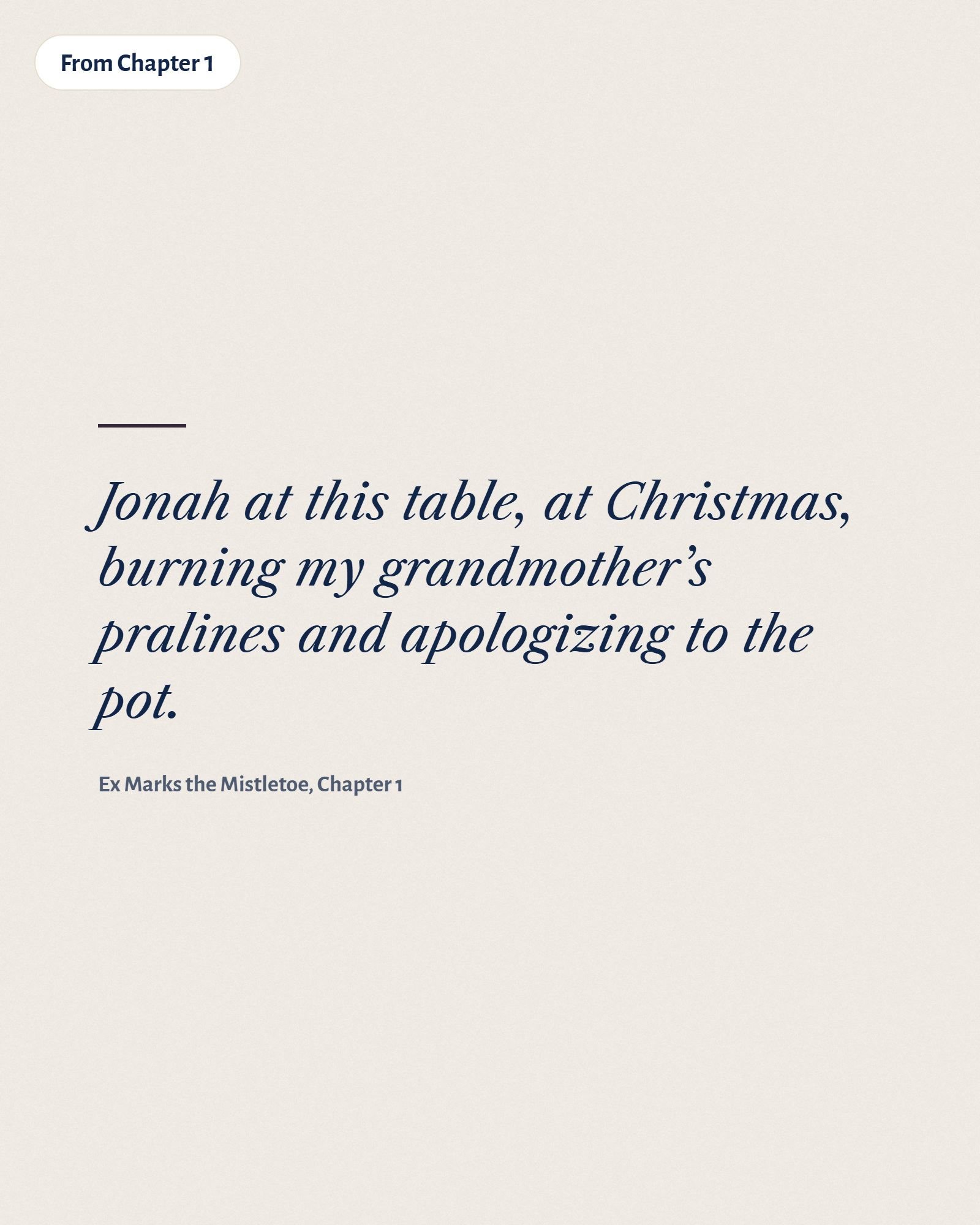
Jonah Avery, in a navy hospital fleece, laughing so hard he had to put down the CPR dummy. Jonah at this table, at Christmas, burning my grandmother’s pralines and apologizing to the pot. Jonah on the phone from Seattle, five years ago this week, saying okay like the word had a crack running through it.
Jonah, who lived across the country. Jonah, who I had not spoken to since the twenty-third of December, 2021.
Home since October.
I looked at my grandmother. She looked at her crossword.
“Seven letters,” she said. “’A light left burning.’ I think it’s vigil. No, that’s five.” She erased a square.
I could have said it right then. Grandma, we’re not together. I don’t know what you’re talking about. I haven’t seen him in five years. It would have taken one sentence. I’m good at sentences. I write cue notes for a living, and cue notes are nothing but sentences, short ones, with no room for feelings in them.
But my mother was still turned around on the piano bench, and her face was still open, and she said, in a small voice, “Oh, Lib. Oh, honey. Why didn’t you tell us?”
And Denise was already reaching for her phone to un-invite an orthodontist.
And this was the last week of the house. The last Christmas in this kitchen with the green light and the yellow table and the dent in the linoleum where Daddy dropped a cast-iron skillet in 1999. My grandmother was eighty-eight. She used the counter to stand up now. She’d planned this, the way she planned everything, in pencil.
I didn’t say the sentence.
I opened my mouth to say it’s complicated, which is what people say when they mean I’m about to lie to everyone I love. I didn’t get to say that either.
The doorbell rang.
Every head in the kitchen turned toward the front hall. Through the doorway I could see down the length of the house, past the boxes and the piano and the bare tree stand waiting in the corner, to the front door with its old wavy glass window. The glass made everything on the other side look like it was underwater.
There was a shape on the porch. Tall. Navy blue. Holding something round and flat in both hands. A pie, or a cookie tin, or an apology.
“Well,” said Grandma June, setting down her pencil. “Somebody get the door. He’s early. He always was.”
That's the end of Chapter 1. The rest of Ex Marks the Mistletoe is waiting.
Get the eBook · $0.99What you get
- FormatEPUB eBook, instant download
- LengthAbout 43,000 words
- Reading timeAbout 3 hours
- Chapters18 + epilogue
- SeriesBook 1 of Holly Street Christmas
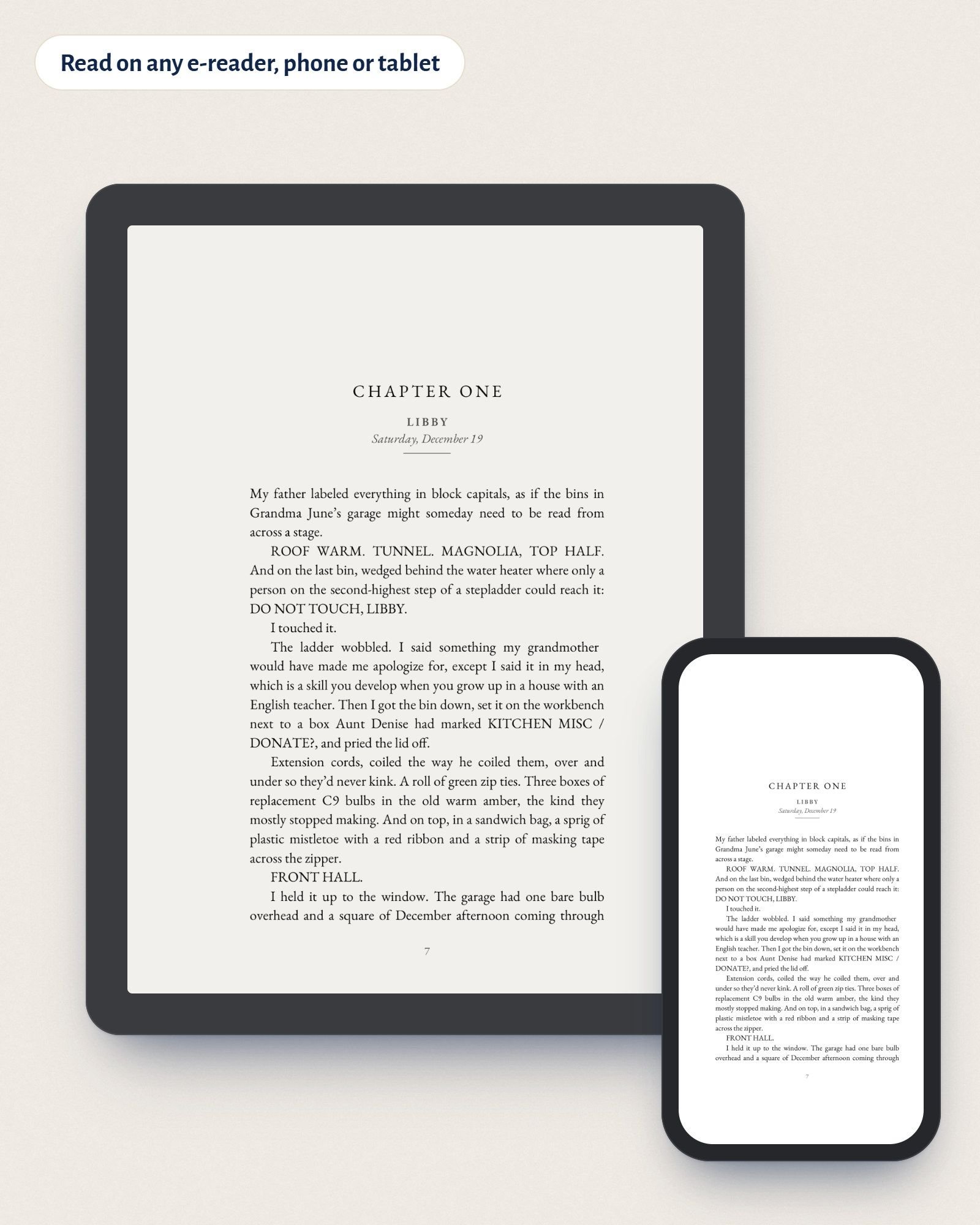
- Read onAny e-reader, phone or tablet
Who it's for
- Readers who love cozy, clean Christmas romance
- Fans of second chances, fake dating and big-hearted Southern families
- A short, warm read for December evenings
Free gift
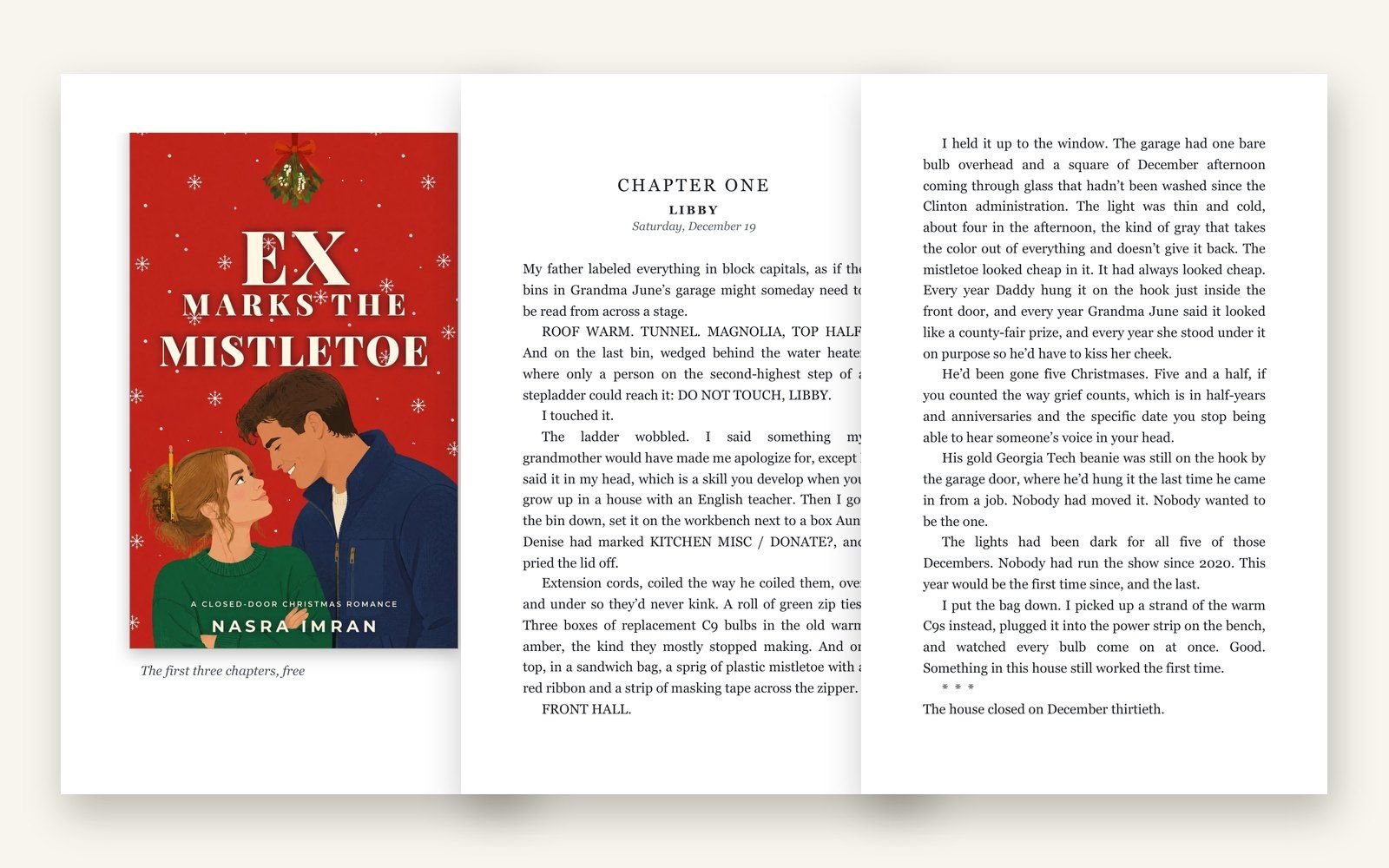
Free: Ex Marks the Mistletoe: first 3 chapters
Start the clean, closed-door Christmas romance free, on your phone tonight. A PDF sent to your inbox.
Questions
How do I get my eBook?
Right after you pay, Payhip shows your download link and emails it to you. On a phone, open the email's link in Safari or Chrome, not inside the email app, and save the EPUB. Not in your inbox? Check Promotions or spam.
Reading it on your e-reader, phone or tablet
The EPUB opens in Apple Books, Google Play Books, Kobo and most e-reader apps. Our Reading on your device page has steps for each device.
Content notes
Closed door, kisses only. No profanity and no alcohol. Content notes: grief (a late parent).
Problem with your file?
If your file won't download or open, isn't what we described, or has a mistake, email us at community@oneandonlystories.com within 30 days of purchase. We'll send a fixed file or a full refund, your choice. Because these are instant downloads, we can't refund a change of mind, but a real person will always help you get the file working first.
Written by Nasra Imran
Novels for adults: warm cozy fantasy, psychological thrillers about marriages with secrets, and closed-door love stories about second chances and the people who leave a light on for us.
More from Nasra Imran