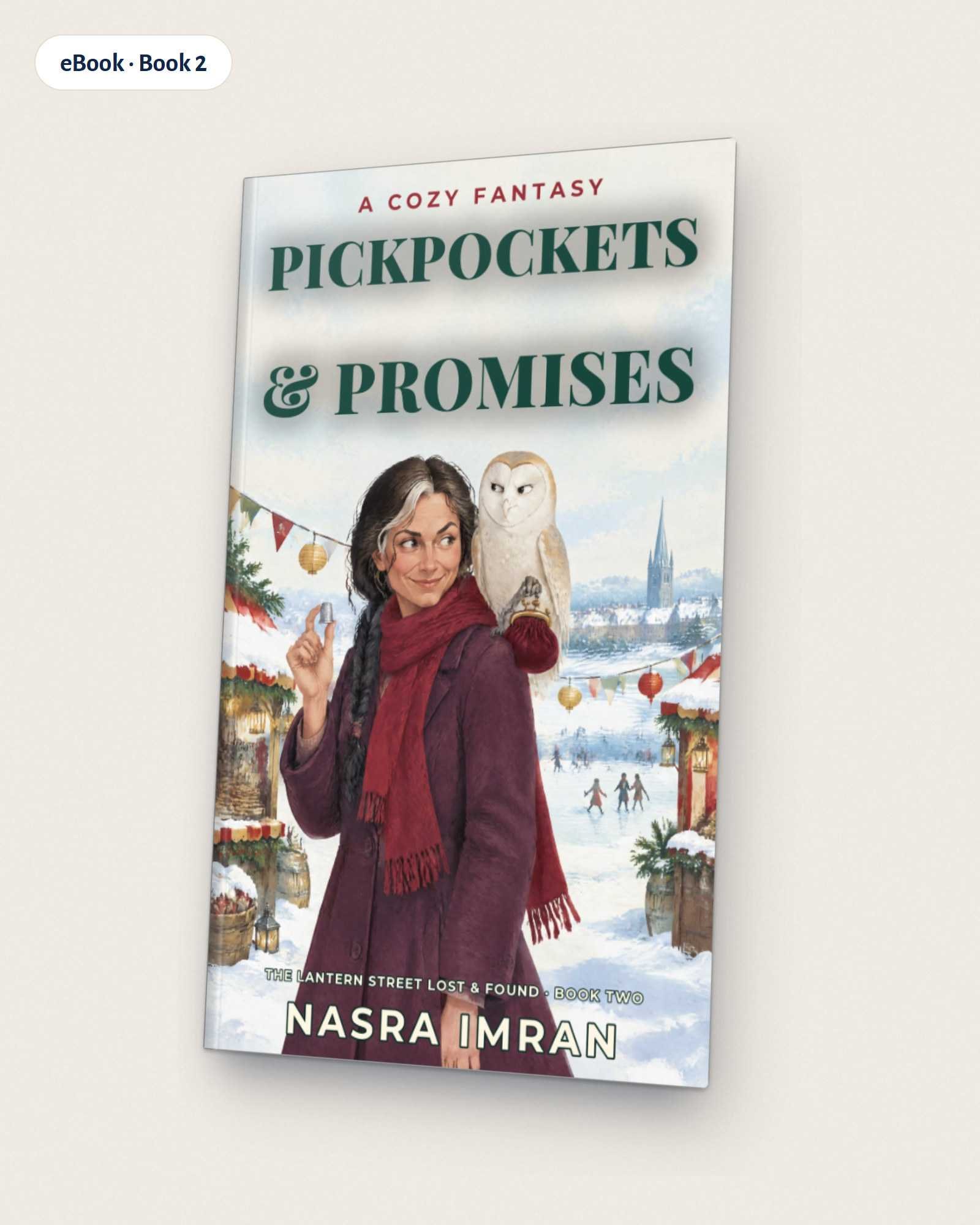
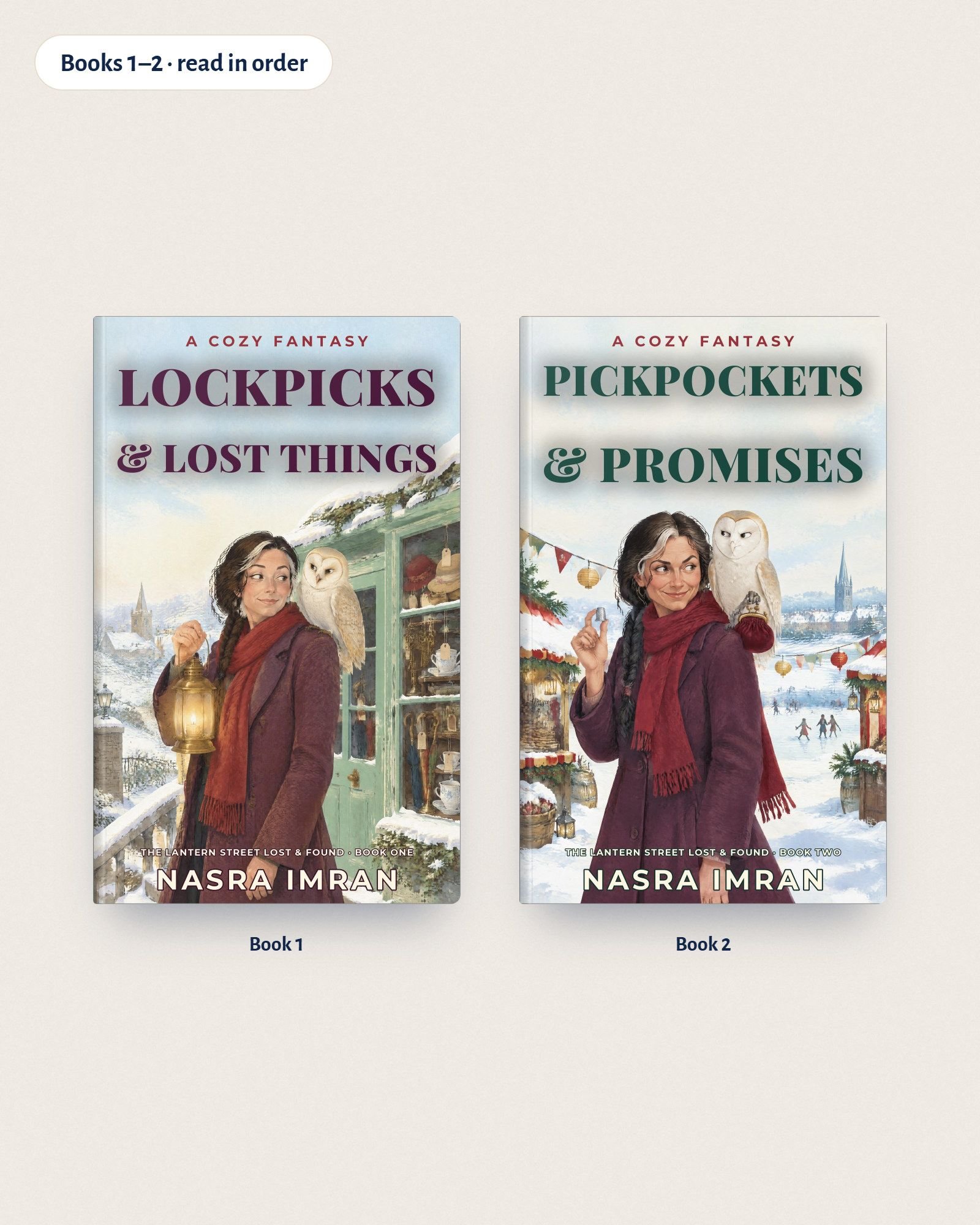
The Lantern Street Lost & Found · Book 2
Pickpockets & Promises
Somebody is picking pockets at the Winter Festival. Every empty purse comes home to the reformed thief.
- Found family
- Low stakes
- Closed door
- No spice
- Happy ending
$4.99
Coming soon: January 2027. One email on the day it comes out.
The story
Clem Rook gave up stealing to keep the magical Lost & Found on Lantern Street. Now all of Copperbell is out on the ice for the Winter Festival, a riddle hunt sends the whole town racing every morning, and purses are vanishing in the crush.
In Copperbell, lost things always find their way home, and every emptied purse lands on the reformed thief’s counter. The town is starting to wonder. A complaint is waiting to be signed the morning after the parade. And Captain Abel Hart, who finally asked her properly, is keeping a letter from Saltgate folded in his coat.
To keep her name, her home and the man she loves, the Keeper will have to catch a thief better than she ever was, with help from a very opinionated barn owl and a town that is about to find out what it really saw.
Read Chapter 1 free
Open Chapter 1 (about 11 minutes)
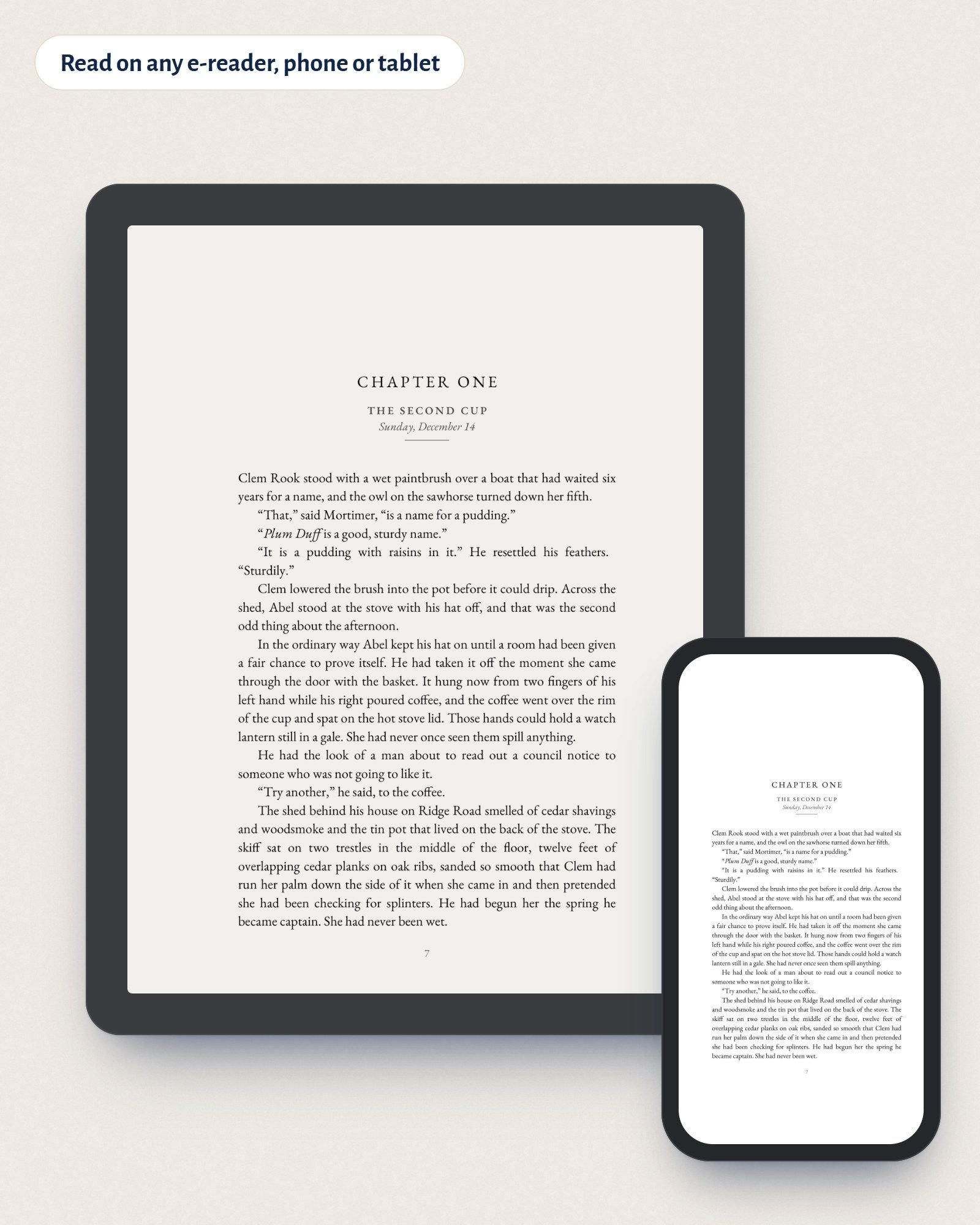
Chapter one
Clem Rook stood with a wet paintbrush over a boat that had waited six years for a name, and the owl on the sawhorse turned down her fifth.
“That,” said Mortimer, “is a name for a pudding.”
“Plum Duff is a good, sturdy name.”
“It is a pudding with raisins in it.” He resettled his feathers. “Sturdily.”
Clem lowered the brush into the pot before it could drip. Across the shed, Abel stood at the stove with his hat off, and that was the second odd thing about the afternoon.
In the ordinary way Abel kept his hat on until a room had been given a fair chance to prove itself. He had taken it off the moment she came through the door with the basket. It hung now from two fingers of his left hand while his right poured coffee, and the coffee went over the rim of the cup and spat on the hot stove lid. Those hands could hold a watch lantern still in a gale. She had never once seen them spill anything.
He had the look of a man about to read out a council notice to someone who was not going to like it.
“Try another,” he said, to the coffee.
The shed behind his house on Ridge Road smelled of cedar shavings and woodsmoke and the tin pot that lived on the back of the stove. The skiff sat on two trestles in the middle of the floor, twelve feet of overlapping cedar planks on oak ribs, sanded so smooth that Clem had run her palm down the side of it when she came in and then pretended she had been checking for splinters. He had begun her the spring he became captain. She had never been wet.
Eleven boats had come out of this shed before her, none of them named, none of them sailed by the man who built them, because Abel Hart was a man who built boats and would not sail them. He gave them away to people who would. This one he had kept.
“Heron,” Clem said.
“That is the name of a horse,” said Mortimer. “The miller’s. It bites.”
Mortimer had been logged in Vol. III of the office ledger, sixty-four years ago, as a very small owl found in the umbrella stand, and the Lost and Found had kept him ever since, which in his view made him senior to everyone in the shed and to most of the town. He had ridden up Ridge Road in Clem’s market basket under a dish towel, objecting to the daylight the whole way, and now sat on the end of the sawhorse with his eyes narrowed to two dark slits against the window.
“Cachet,” Clem tried. “It means a seal of approval.”
“It is a sneeze.”
“It’s a perfectly respectable word.”
“Say it quickly.” Mortimer waited. “You see.”
Abel made a sound into his cup that might, in another man, have been a laugh. He set the cup down on the bench by the door, next to a second one he had poured for her twenty minutes ago from the tin pot and then forgotten. Tea, with honey. It had stopped steaming long since, and grown a skin.
Clem looked at that second cup a long moment.
She let it be. She went round to the stern of the skiff, where the transom stood broad and bare and pale, and loaded the brush, and began.
She had good hands for small work, and fewer uses for them than she once had. She used them now for a capital S and then the rest, plain white letters with no flourish, the way a thing ought to be written if it meant to be read from the bank. Mortimer turned his head round to watch, a long way round. Abel kept to the stove until she stepped back and wiped the brush on the rag.
SECOND CUP.
He read it. He read it again. He stood there longer than a man needs to read two words, with his hat hanging from his fingers, and she watched the back of his neck go red above the collar of his coat.
“October,” he said.
“I poured you a cup on a Saturday in October,” said Clem, “and you said no, and it went cold on the bench.”
“I remember.”
“So do I, apparently.” She nodded at the bench by the door, where his forgotten cup sat going cold beside his coffee. “You’ve done it again. I thought she ought to be named for something you’d learned not to waste.”
Abel kept his back to the bench and his eyes on the transom, on the wet white letters, as if they might run if he left them.
“Acceptable,” said Mortimer, from the sawhorse. “It will need to be logged.”
“It’s a boat.”
“Everything in this town is logged eventually, Keeper. I am.”
Abel laughed then, a short one, surprised out of him. He put the hat down at last on the shelf above the stove. He picked it straight back up again. He held it in front of him in both hands, turning the brim, and Clem saw the hands were not steady yet and understood that whatever had been coming all afternoon was coming now.
“I asked Hattie how this was done,” he said.
“How what was done?”
“Asking properly.” He turned the hat a quarter turn. “She laughed for a quarter of an hour. I timed it by the clock over her ovens. Then she gave me a doughnut and told me to stop being a fool and say it plain.”
“Was it a good doughnut?”
“It was an excellent doughnut. It didn’t help.” He took a breath and let it go and squared himself, as he did on the watch-house steps before he told a crowd to go home. “Clem. I would like to walk out with you at the Winter Festival. The opening. The skating on the Elbow. The candles down to the river on the last Saturday. The parade at the end.” The hat stopped turning. “Every day of it, where the whole town can see.”
The whole town had seen a good deal of her already. Eleven days ago she had stood on the green in the snow and told every soul in Copperbell that she was the Magpie, the thief on the paper in every watch house on the river, and Copperbell had heard her out and decided to keep her anyway. She was still getting used to it, and not at all sure she meant to.
“Every day of it,” she said.
“Twelve. And the parade.”
“That’s thirteen.”
“I can count, Keeper.”
“Yes,” said Clem.
He blinked at her. “Yes, I can count?”
“Yes, Abel.” She put the brush down on the rag before she dropped it. “Every day of it. Where the whole town can see. Yes.”
He put the hat on the sawhorse beside the owl, which Mortimer bore without comment, and crossed the shavings in two steps, and kissed her. It was short, and his nose was cold from the window, and there was white paint on her thumb that went somewhere on his coat and stayed there. Afterward his palm rested against her cheek a moment, and it had quite stopped shaking.
“I am still here,” said Mortimer.
“We know,” said Clem.
“I mention it for the record.”
Abel went back to the stove and poured himself a fresh cup of coffee, all the way to the brim, and did not spill a drop. He tipped the cold tea out the door into the snow and filled her cup again from the tin pot, with honey, and stood close beside her while they watched the paint dry on the name.
They walked home at dusk with the basket between them.
Ridge Road ran down past the school and the stone cottages of School Hill, with snow to Clem’s knees on either side of the track. The light was going blue. Every chimney in town had its thread of smoke standing straight up in the still air, and the lamps were being lit along the green one at a time, as if somebody were walking round it with a single match.
They heard the boy before they saw him.
He was five or so, in a brown coat buttoned wrong, standing by the bandstand with one red mitten on and one bare fist held out before him like evidence, howling. His sister, by the look of the chin, held his sleeve and searched the snow round their boots.
“Lost it,” she said, when Clem stopped. “He had both when we came across. I’ll catch it from Mama.”
Clem set down her side of the basket.
Out here the snow did not hum. Nothing did, out of doors. The hum lived only in the old oak of the counter and the shelves, and for anything else she had what she had always had, which was her eyes and a habit of reading where people had been. She looked at the snow.
Small boots, coming across from Tinder Lane, toes turned in. A wide scuffed place where he had stopped. Two dents together, deeper than the rest, where he had knelt. Beside them, the print of a bare small hand, fingers spread, pressed flat to pack a snowball, because a snowball packed better without a mitten and every child in the world knew it. So the mitten had come off and gone under his arm. Last came the throw: the boots turned, the left one dug in hard. She followed the line of it to the bandstand rail, where a white star of snow was stuck to the post at about the height of a man’s belt.
A poor throw. A good arm, though. When his arm went up, the mitten had gone wherever it liked.
The snowbank under the bandstand steps had a red thumb sticking out of it.
Clem pulled it free, knocked it twice against her knee, and held it out. The howling stopped at once.
“How’d you know?” said the sister.
“He took it off to make a better snowball,” said Clem. “Everybody does.”
“It packs better with hands,” the boy told her, in the voice of someone sharing a great secret, and put the mitten on wrong way round, and was towed off toward Tinder Lane by the sleeve.
Two minutes, by Old Grumble’s quarter. Abel had stood at the edge of the path the whole time and not offered to help. She had come to like that about him.
“You didn’t even go near the counter,” he said.
“Snow doesn’t hum.”
“Most people would have searched the shelves all night.”
From the basket, Mortimer said, “He threw it badly. That is why it hit the rail.”
They crossed the green past the blue door of the watch house. A lamp burned in its window and another in the Council House front hall across the snow, where the town’s little copper bell sat in its glass case on red velvet with a light beside it all night now. Clem looked across at it, as she always did.
“Anything from Saltgate?” she said.
“Not yet.”
The night after the ringing Abel had written to the magistrate in Saltgate on her behalf, and sent the letter down the river with Sergeant Fitch, and told her not to sit up waiting for an answer.
“Friday’s packet, maybe,” he said. “Maybe not till after the year’s turn. They’re slow down there.” He shifted his grip on the basket. “So am I.”
The light had gone. Mortimer put his head out from under the dish towel, rose out of the basket without a sound, and was a pale shape over the Council House roof and then nothing at all, gone south toward the river meadows to see what was under the snow.
“Keeper! Captain! On the green on a Sunday, the two of you, and in the dark. There’s a headline.”
The man coming toward them from the Council House steps was stooped from a lifetime of leaning over type, with a long moss-brown muffler wound twice round his neck and the ends flying. He had a bundle of posters under one arm and a brown leather satchel on his hip stamped THE COPPERBELL CRIER in worn gilt. His round spectacles were pushed up on his forehead and forgotten there. When he put out his hand to Abel, the thumb and first finger were ground blue-black with ink that no soap was ever going to shift.
“Mr. Goodwin,” said Abel.
“Ezra, Captain, for pity’s sake, you’ve known me twenty years.” Ezra Goodwin’s bright eyes went to Clem. Bushy gray eyebrows went up and down as he talked, two busy creatures with opinions of their own. “And the Keeper. Just the woman. I was coming down to you with this and I’d have had to put it through your slot, and the setter frowns on slots.”
He drew a long cream envelope from inside his coat. It was sealed with a blob of plain red wax, no mark pressed in it, nothing written on the front.
“For the setter,” he said, “as always.”
Clem took it. It was stiff and a little heavier than one sheet.
“You’ll want the history,” said Goodwin, who plainly wanted to give it. “Medallion Hunt, since eleven-oh-one. A brass medallion hidden before dawn on the first day, a riddle at the bandstand every morning at half past seven for twelve days, each one nearer the spot. Finder gets twenty-five crowns and the lead sleigh in the torchlight parade. Nobody knows the setter but the committee chair. The sealed copy goes to the Keeper by custom, so there’s one copy in the world nobody can tamper with. The printer gets each riddle the night before to set it, and the printer,” he added, “is a humble tradesman and knows nothing whatever.”
“Who’s the setter, then?” said Abel, dry.
“Half the town will ask me that on Tuesday and I’ll tell them what I tell them every year. I only set the type.” Goodwin hitched the posters higher. “The Crier, eleven-nineteen: ‘The medallion was found this year by Mrs. Lusk’s spaniel. The spaniel has declined the sleigh.’”
Clem’s mouth gave her away.
“There,” said Goodwin, delighted. “I’ll walk you down. I’ve got a poster for your window, if the lantern will share.”
He gave her one off the bundle as they went. FREE! it said, in letters an inch high. THE FESTIVAL NUMBER OF THE COPPERBELL CRIER. FOUR PAGES. TUESDAY AT MARKET. BRING THE WHOLE FAMILY.
“Free,” said Abel.
“Free costs me plenty,” said Goodwin, cheerful. “But a town that won’t read about its own festival isn’t a town, it’s a lot of houses.”
They came down Lantern Street together in the dark, the snow squeaking under their boots, and halfway down the hill Clem saw the office before she saw anything else. The old ship’s lantern sat in the front window of No. 9 on its board of dark oak, where the town had lent it back to her, and Hattie, who had a key and opinions, had lit the lamp behind it. Red light lay on the snow on one side of the step and green on the other, two long soft colors on the white, and the green door stood between them.
“Now that,” said Goodwin, “I’d print, if I could print color.”
Inside, the office was cold and smelled of beeswax and banked coals. Clem lit the lamp at the slant desk and opened the great ledger to the last page with writing on it. She gave Abel the envelope to hold, and he held it a little away from his coat while she found her pen, as a man holds anything that belongs to somebody else.
She wrote in her smallest hand.
No. 438. Dec. 14. One envelope, sealed, plain red wax, no mark. Handed in by E. Goodwin for the Hunt setter. Held under Article 9.
“Sealed things are held until claimed,” she said, for Goodwin’s benefit, because he was leaning over the counter to read it upside down. “Never opened. Never forced. Only the one who handed it in can claim it.”
“Safer than in my shop, goodness knows,” said Goodwin. “My shop has apprentices.”
She carried it back down the aisles to the Valuables Cage and laid it on the shelf inside, by itself, and locked the cage door, and tried the door once with her fingers, out of habit.
Goodwin went off down the hill toward Mill Street with his muffler flying, calling back that the Festival Number would be the best four pages he had ever printed, and that she should bring the town. Abel waited on the step until the dark had him.
He remained outside, just past the green door, between the red light and the green, with his hat back on and white paint on his coat.
“Seven o’clock on the twenty-fifth,” he said. “I’ll knock.”
“The door’ll be open.”
“I’ll knock anyway.”
That's the end of Chapter 1. The rest of Pickpockets & Promises is waiting.
Reading order
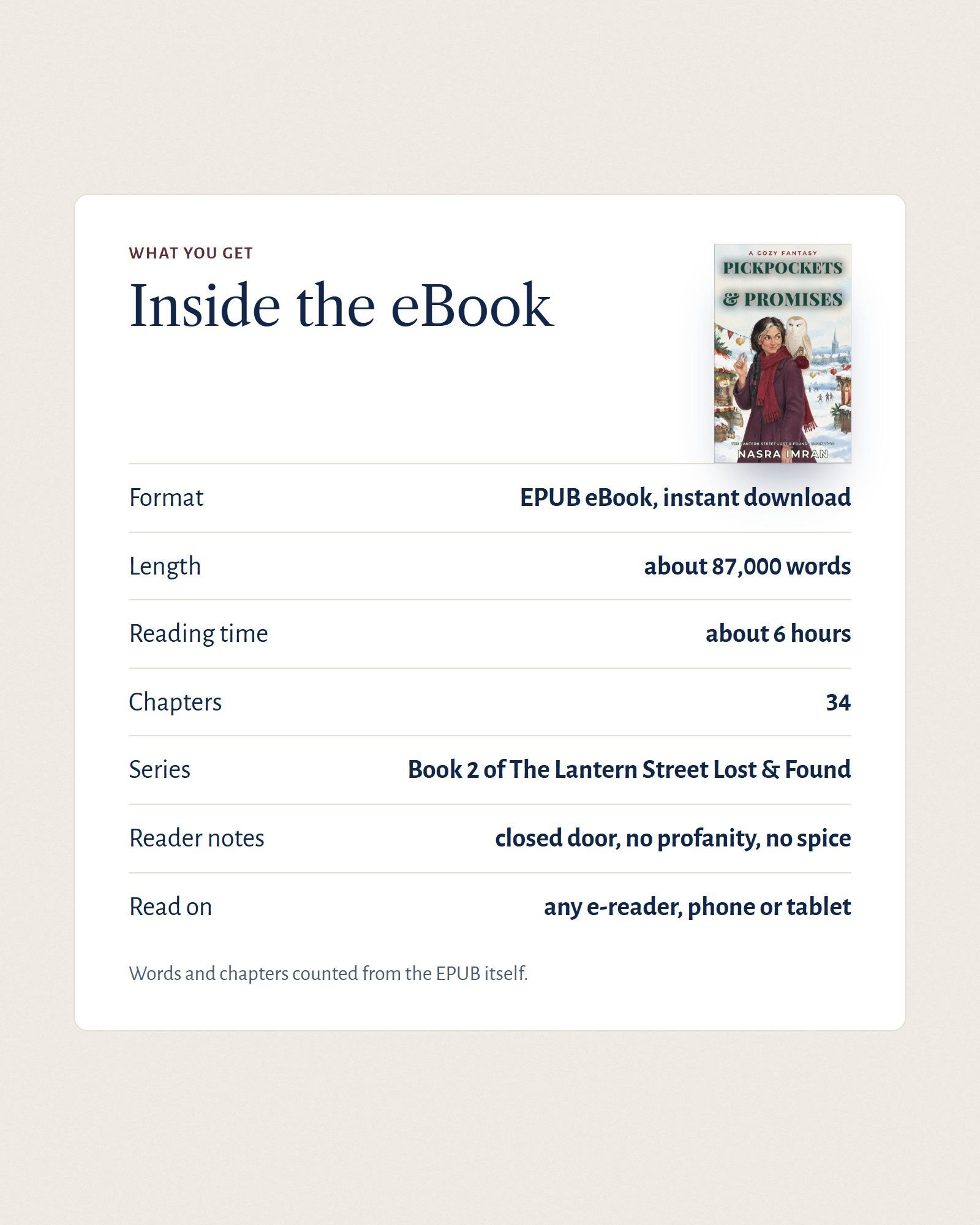
What you get
- FormatEPUB eBook, instant download
- LengthAbout 87,000 words
- Reading timeAbout 6 hours
- Chapters34
- SeriesBook 2 of The Lantern Street Lost & Found
- Read onAny e-reader, phone or tablet
Who it's for
- Readers of Lockpicks & Lost Things who want more of Clem and the owl
- Fans of cozy fantasy mysteries with a fair-play puzzle
- Readers who prefer closed-door romance with no spice
Free gift
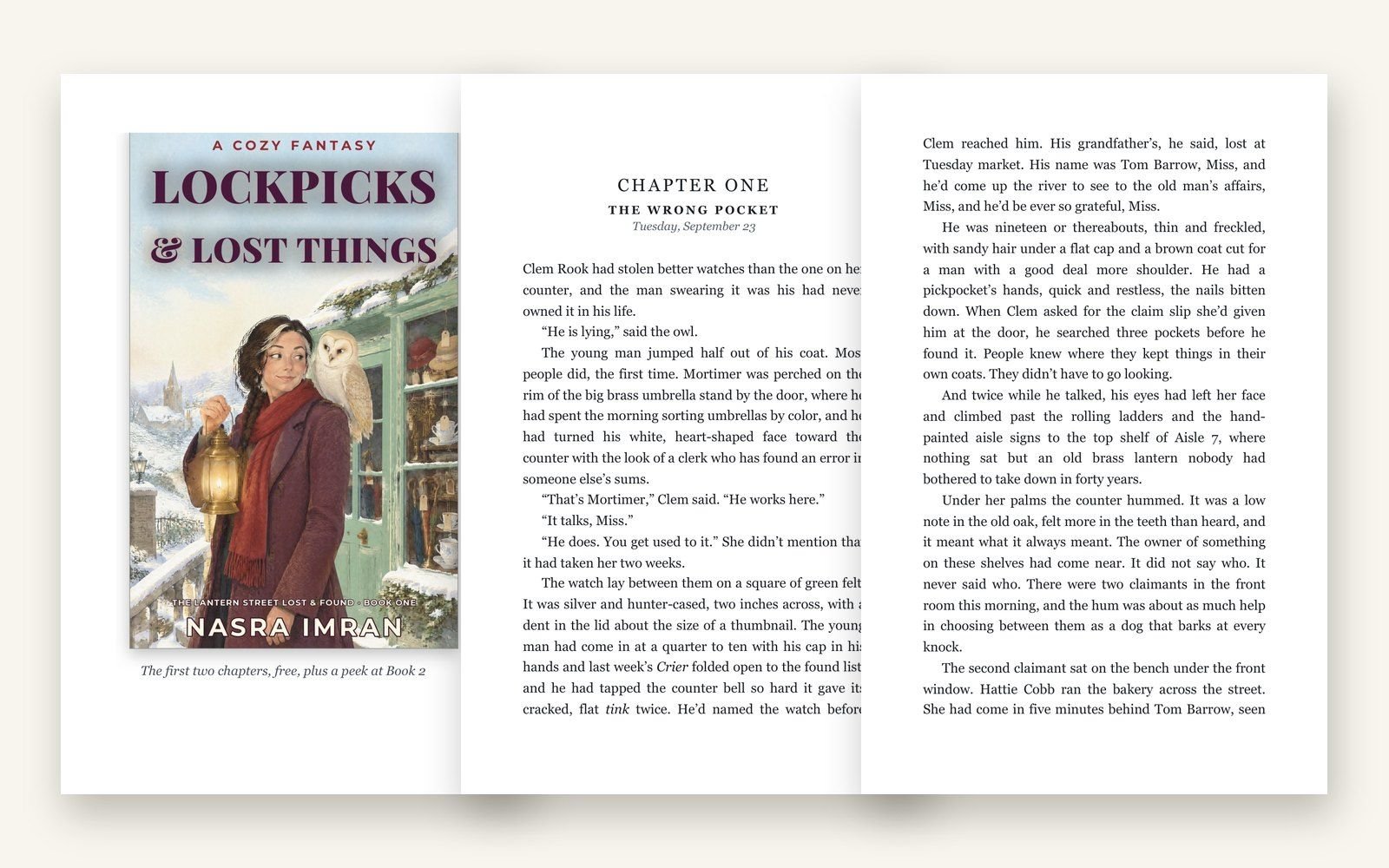
Free: Lockpicks & Lost Things: first 2 chapters
Start the cozy fantasy free, with a peek at Book 2. Found family, gentle capers and one very opinionated barn owl.
Questions
How do I get my eBook?
Right after you pay, Payhip shows your download link and emails it to you. On a phone, open the email's link in Safari or Chrome, not inside the email app, and save the EPUB. Not in your inbox? Check Promotions or spam.
Reading it on your e-reader, phone or tablet
The EPUB opens in Apple Books, Google Play Books, Kobo and most e-reader apps. Our Reading on your device page has steps for each device.
Content notes
Cozy fantasy mystery with a closed-door, slow-burn romance (no spice): kisses on the page, the door stays closed. No profanity.
Do I need to read Book 1 first?
It can be read on its own, but it is best after Lockpicks & Lost Things.
Problem with your file?
If your file won't download or open, isn't what we described, or has a mistake, email us at community@oneandonlystories.com within 30 days of purchase. We'll send a fixed file or a full refund, your choice. Because these are instant downloads, we can't refund a change of mind, but a real person will always help you get the file working first.
Written by Nasra Imran
Novels for adults: warm cozy fantasy, psychological thrillers about marriages with secrets, and closed-door love stories about second chances and the people who leave a light on for us.
More from Nasra Imran